Coat hooks without a crowded entrance
Coat hooks become crowded when their spacing is planned around empty hooks. Jackets, scarves and bag straps need much more room than the hardware itself, especially beside an entrance door.
Place coats before placing holes
Hang the widest coat you regularly use on an existing door or temporary stand and measure its occupied width. Consider the thickness of several winter coats, not just the flat shoulder width. Mark proposed hook positions with removable paper, then hold the coats against them. This reveals whether neighboring sleeves overlap a light switch or cover the door handle before any drilling begins.
Choose heights for the people who will use the hooks. A lower row can give children their own reachable place, but it should not sit directly beneath long adult coats. Bags need consideration too: a long strap on a high hook may leave the bag resting on shoes. Separate zones for coats and bags are often easier to use than one tightly packed row.
Match the fixing to the surface
A hook's stated load is only part of the installation. Check the wall construction and the complete manufacturer's fixing instructions. The correct fastener depends on the actual surface; a supplied screw does not establish that the included plug suits every wall. Before making holes, establish that the location is appropriate and free of concealed services, using qualified help when you cannot verify it.
Adhesive hooks have their own surface, preparation and waiting-time requirements. Do not transfer a load claim from one adhesive system to another or assume textured paint will behave like a smooth tile. Over-door hooks avoid wall holes but need clearance above and behind the door. Try the closed-door movement with the proposed dimensions, including any pad intended to protect the finish.
Think about the shape of the hook
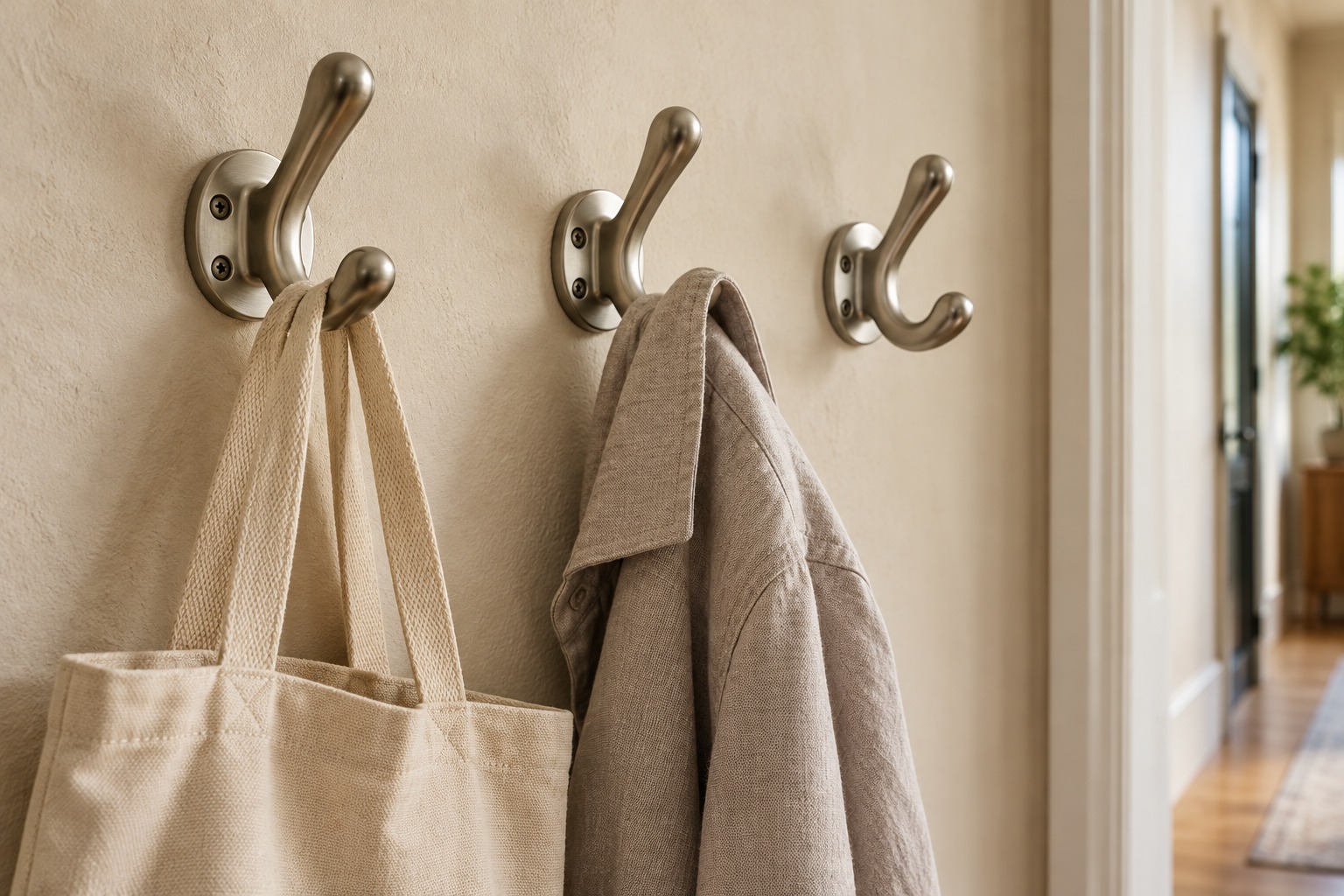
A broad rounded end supports a hanging loop differently from a narrow pointed projection. Test whether your coat loops and bag straps actually fit over the shape. Double hooks appear space-efficient, but an upper item may cover the lower one. If every departure requires removing two other garments, the arrangement is storing more than it can conveniently serve.
Leave a place for wet outerwear to dry according to its care instructions before pressing it into a full row. Periodically remove items that no longer belong near the door. Check accessible screws and fittings as directed by their manufacturer, and stop using a hook that has become loose or damaged. A few well-spaced positions usually keep an entrance more usable than filling every available stretch of wall.