Expanding files for active paperwork
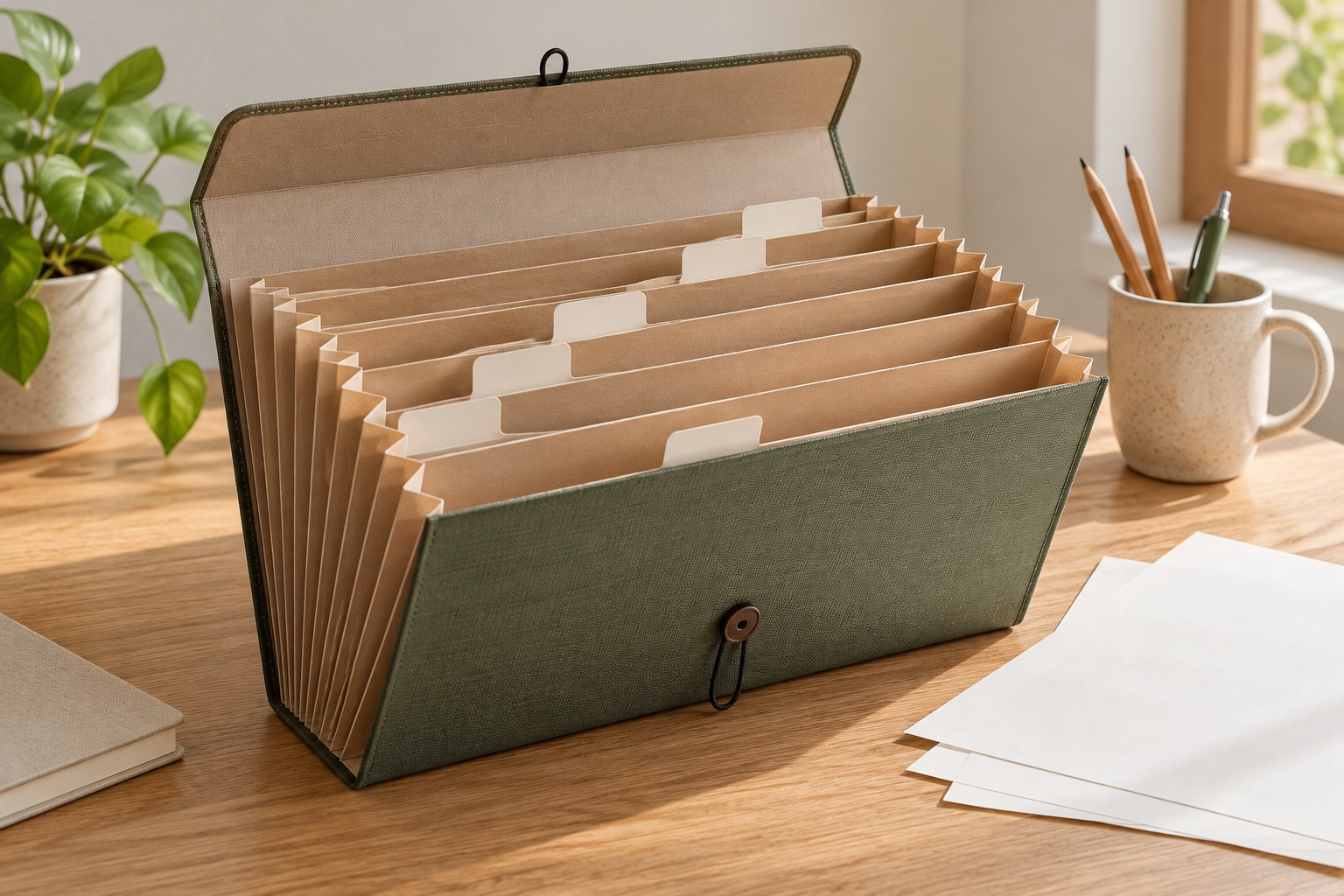
An expanding file works best for papers that are still moving through a process. Its pockets should reflect the next action or a clearly defined subject, while its closure must cope with the actual filled thickness.
Choose a purpose for the pockets
Decide whether the file organizes ongoing bills, a house project or documents carried to appointments. Avoid combining every household subject simply because many pockets are available. A small number of useful sections is easier to maintain than a large sequence with vague labels. Leave a pocket empty if it has no real job.
For active paperwork, headings such as 'to review,' 'waiting' and 'completed for filing' can describe movement through the process. For a single project, supplier or room names may be clearer. Use the terms you naturally search for. The system should make the next action visible rather than hide an unfinished task behind an attractive cover.
Check the pockets with real documents
Insert a representative set including envelopes, receipts and any folded sheet you normally keep. Measure the usable pocket width and height, not just the outer case. Tabs and dividers should remain visible when papers are inserted. A pocket that swallows small receipts may need a labeled envelope rather than a more complicated file.
Spread the file on the surface where you will use it and see how wide it opens. Some designs need two hands to hold the pockets apart. Check whether you can retrieve one sheet without pulling neighboring papers out. A comfortable working capacity is usually lower than a tightly packed maximum.
Test the closure after filling
An elastic loop, flap or zipper must close without bending papers or pulling excessively on the seams. Try the file at the expected everyday thickness. A handle is useful only when the case and closure are designed to support the carried contents. Do not treat a document organizer as protection against water or other hazards unless those properties are explicitly documented.
If the file travels in a bag, check its corners and closed dimensions against the compartment. Leave space to remove it without scraping the tabs. A light cover may suit short trips, while a rigid case changes the weight and bulk. Compare the whole carried package rather than the organizer when empty.
Set a review point so completed documents leave the active file for their intended long-term storage. Replace unclear labels and remove duplicate copies when appropriate. Expansion is useful breathing room, not a reason to let every pocket grow indefinitely. The file should stay easy to open, understand and close at the moment a document is needed.