Kitchen tongs with secure ends
Kitchen tongs need to close around food without making the hand work harder than necessary. Compare the ends, opening range and spring action before choosing a length or a storage lock.
Match the ends to the task
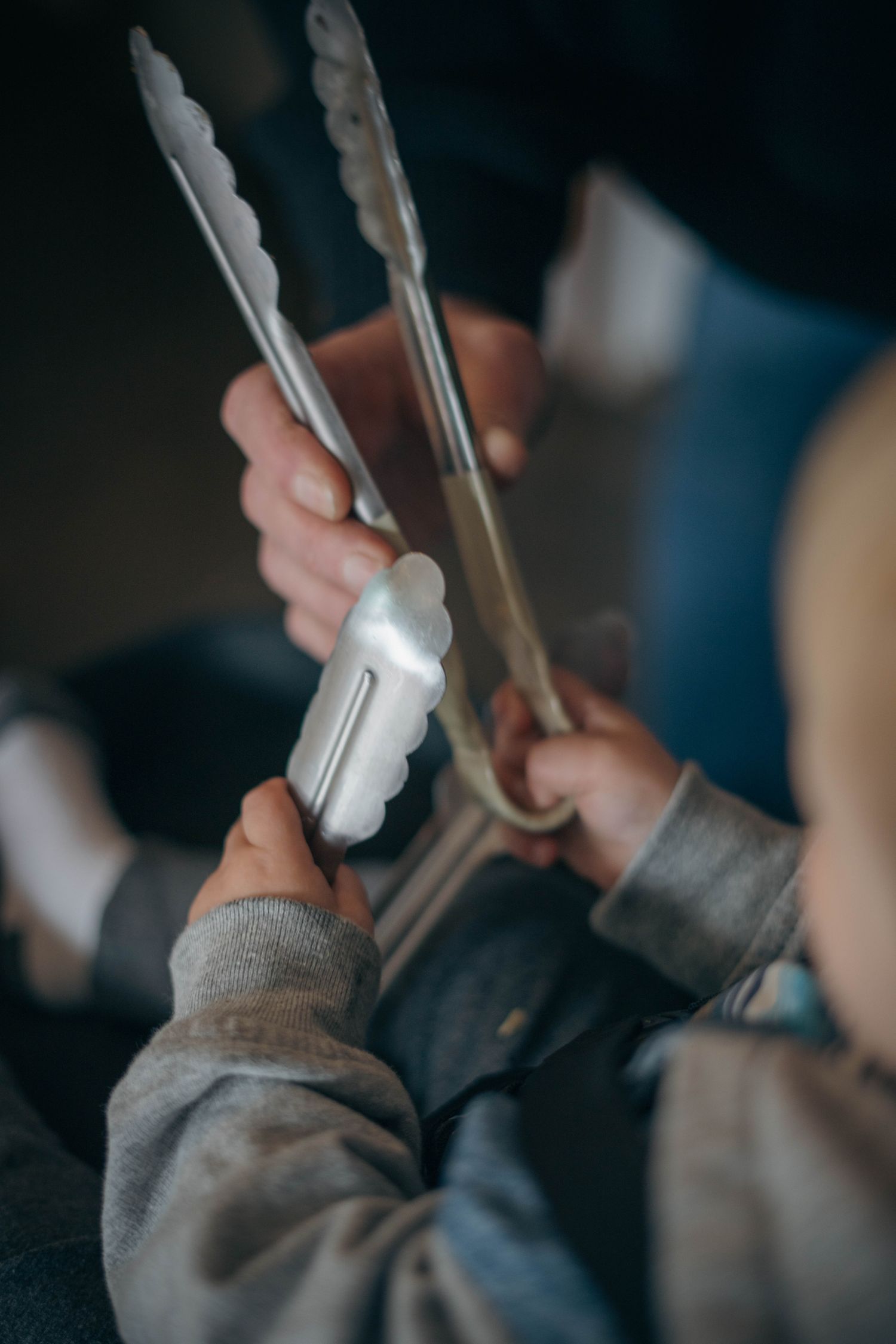
Broad scalloped ends can support different pieces from narrow precision tips. Think about the food you turn, lift or serve most often. A head that works for a large piece may be clumsy with small ingredients, while a very narrow tip can concentrate pressure on delicate food. Check that the ends meet in the way intended by the manufacturer rather than crossing unevenly.
For coated cookware, follow the pan maker's guidance on suitable contact materials. A soft outer covering should be intact, with no exposed hard edge where it meets the food or pan. Read the tong manufacturer's heat and use limits for the complete product. A heat-resistant tip does not automatically make every part suitable for prolonged contact with a hot surface.
Length changes reach and control
Long tongs keep the hand farther from the working end but need more storage space and can be less convenient in a small pan. Short tongs may suit serving bowls or compact tasks. Choose the reach needed for the actual cooking setup, including any relevant appliance instructions, rather than treating the longest option as the most versatile.
Open and close the handles several times where a demonstration model is available. The spring should be manageable for the person using it, and the grip should not pinch at normal positions. A strong spring is not automatically a sign of better control. Check whether the opening can be limited or locked only in the manner described for that model.
Keep the joint clean and the lock clear
Food can collect around the hinge and beneath removable tips. Follow cleaning instructions and do not detach parts that are not designed to come off. If the tongs have a pull-ring lock, check how it is operated and whether the ring is also intended for hanging. Similar-looking mechanisms can have different functions.
Store the tongs so they do not spring open into sharp tools or block a drawer from closing. Inspect the hinge, tips and lock during cleaning. Replace damaged parts only with appropriate identified replacements. A pair that is comfortable to squeeze, easy to clean and shaped for recurring tasks will usually be more useful than an oversized tool chosen for occasional situations.