Mixing bowls that nest well
Nesting bowls save cupboard space only if the sizes inside the set are useful and easy to separate. Start with the mixtures you make, then compare the stack as well as each individual bowl.
Capacity needs room for movement
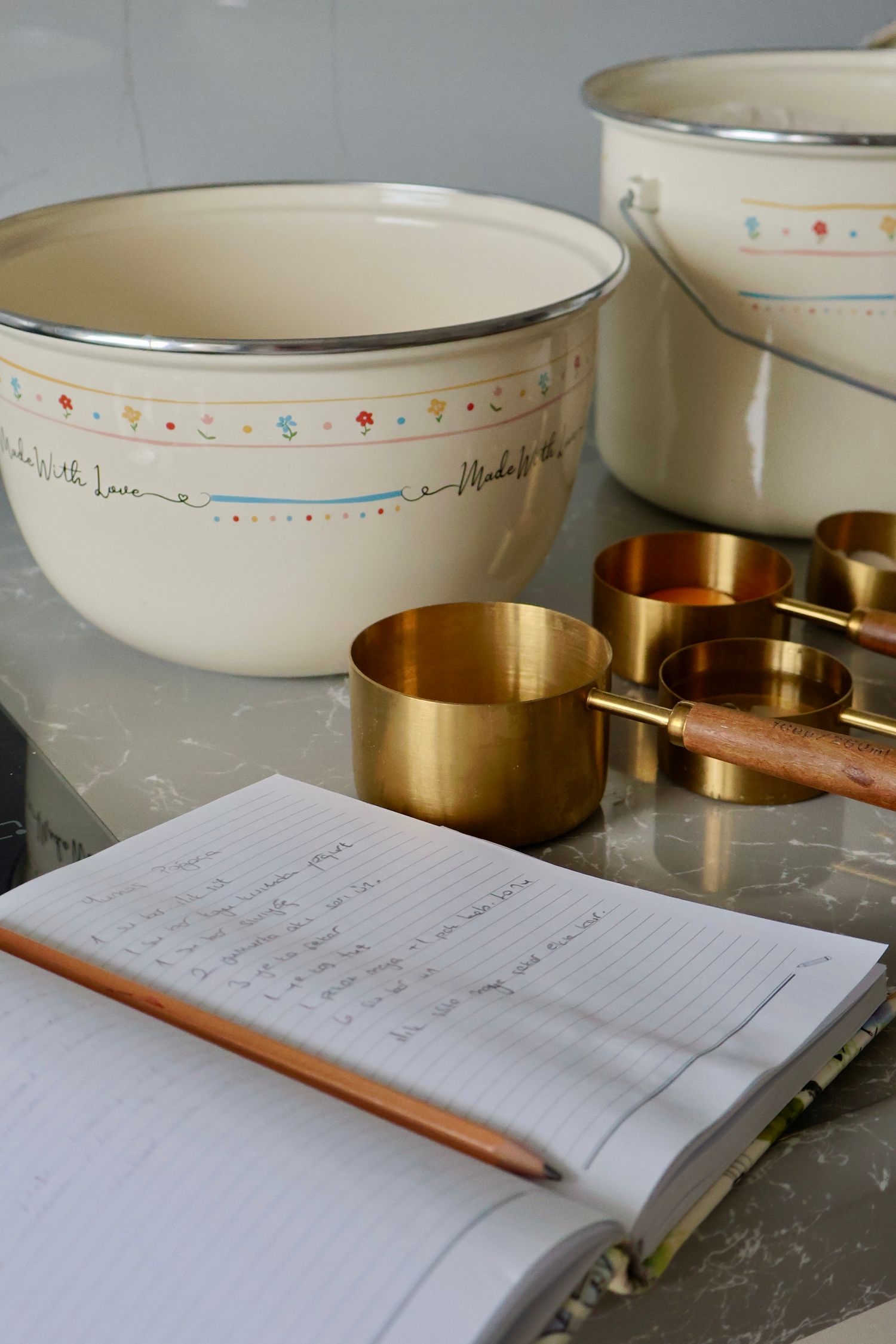
A bowl's stated volume describes capacity, not necessarily a comfortable mixing quantity. Whisking, folding and tossing need space above the ingredients. Think about a usual batch and how far the mixture moves while you work. A wide shallow bowl and a tall narrow one can hold similar amounts but give very different access to a whisk or spatula.
Check whether the bowl fits on the kitchen scale without hiding its display. If a hand mixer will be used, confirm that the bowl's material and shape are appropriate for that equipment and task. Keep handles and pouring lips clear of the mixer's movement. Do not assume a decorative serving bowl is suitable for the same work simply because it has the desired volume.
Examine the nested stack
Compare the total stacked height with the shelf opening, including lids if they will be stored on the bowls. Handles, rubber bases and wide rims can prevent close nesting. A set that looks compact in a photograph may need a particular order that becomes inconvenient when one middle-sized bowl is in use. Try to understand how each piece can be removed independently.
Avoid forcing bowls together when their fit is tight. Check for spacers or storage instructions where the materials require them. A non-removable nonslip base may help during mixing but also changes the way the next bowl sits inside. The smallest bowl should not disappear so deeply that it is difficult to grip without lifting the entire stack.
Materials bring different permissions
Read the product's specific instructions for dishwashing, microwave use, oven use or contact with hot ingredients. A general material name is not enough to establish every temperature or appliance permission. Lids and nonslip bases may have different restrictions from the bowl body. Keep those details separate when comparing sets that advertise several functions at once.
Consider weight during washing and pouring. A heavy bowl may feel stable on the counter but be awkward to tip with one hand while scraping with the other. A lighter bowl can be easier to lift yet need a suitable base for the task. Compare the complete handling sequence, including carrying the filled bowl to the sink and placing it to dry.
Buy the sizes you will actually reach for
A three-piece set can be more useful than a larger set if its spacing suits your cooking. One small bowl for a dressing, one medium bowl for preparation and one larger bowl for a batch may cover more work than several nearly identical sizes. Conversely, two bowls of the same useful size can be sensible when they are often needed together.
Check whether replacements can be bought individually. Losing or damaging one bowl should not automatically require another whole set. Store lids where they can be matched easily, and let bowls dry before nesting them as directed. The goal is a stack that reduces storage effort without turning every preparation task into a search through unused sizes.