Rechargeable battery chargers by cell type
The shape of a battery does not tell you how it should be charged. Choose a charger by the rechargeable cell chemistry and the manufacturer's compatibility information before comparing the number of slots or a promised charging time.
Read the cells already in use
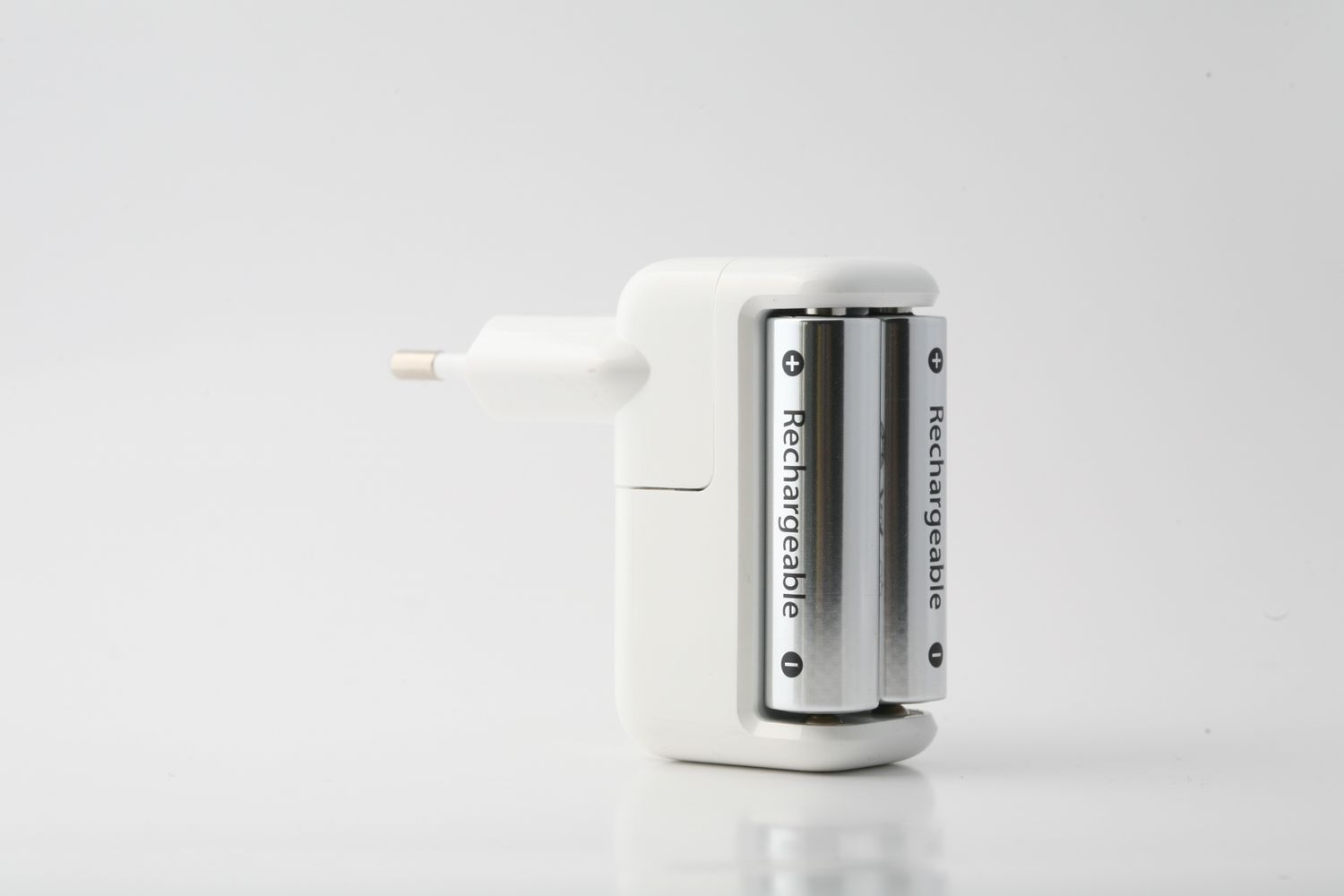
Gather the rechargeable batteries you intend to maintain and read their labels. Record the chemistry, size and any charging instructions. AA and AAA describe sizes, not a universal charging method. A charger intended for nickel-metal hydride cells should not be treated as suitable for another chemistry simply because the cell fits between its contacts.
Keep ordinary disposable batteries out of the charging group. Energizer's guidance states that standard alkaline batteries are not designed to be recharged and should never be placed in a charger. If a label is unreadable or the cell's identity is uncertain, do not use trial charging to find out what it is. Replace uncertainty with the manufacturer's documentation.
Understand the slot arrangement
Check whether each slot is managed independently or whether batteries must be inserted in specified pairs. This matters when a household device uses an odd number of cells. Read the instructions for mixing capacities, sizes or states of charge. A physically spacious charger is not necessarily designed to accept every combination at once.
Inspect the indicators. Separate status information for each cell can be easier to interpret than one light for the entire unit, but only if the manual explains its meanings. Look for a clear response to an incorrectly inserted or unsuitable cell. Avoid assuming that a steady light always means charging has finished; color and flashing patterns vary.
Treat speed as a complete routine
Compare charging-time claims with the capacity and conditions used to produce them. A very short headline may refer to a different battery from the one in your drawer. For household remotes and clocks, a second labeled set of charged cells may be more convenient than buying solely for the fastest advertised cycle.
Give the charger a stable, dry and ventilated place and follow its instructions on supervision, temperature and disconnection. Do not bury it under papers or charge damaged, leaking or swollen cells. Use only the specified power supply. If the unit or a battery behaves abnormally, stop using the combination and consult the manufacturer's instructions instead of repeatedly restarting it.
Keep sets identifiable
Use a small box with separate spaces for charged cells and those waiting to be charged. Mark matched sets in a way that leaves the battery label readable. This reduces guesswork when a device needs replacements. Keep metal objects away from loose battery terminals and follow local collection instructions for batteries that are no longer usable. The charger is one part of a storage and replacement routine, not a cure for worn-out cells.