Doorstops that protect nearby surfaces
The mark behind a door is often made by its handle, not by the door itself. A useful stop interrupts that particular movement before contact, while leaving enough room to enter, clean and move furniture.
Follow the door's actual swing
Open the door slowly and watch which part approaches the wall first. A projecting handle can reach paintwork well before the edge of the leaf. In another room, the door may strike a cabinet, radiator cover or adjoining door. Identify that contact point before deciding whether the stop belongs on the floor, baseboard or wall.
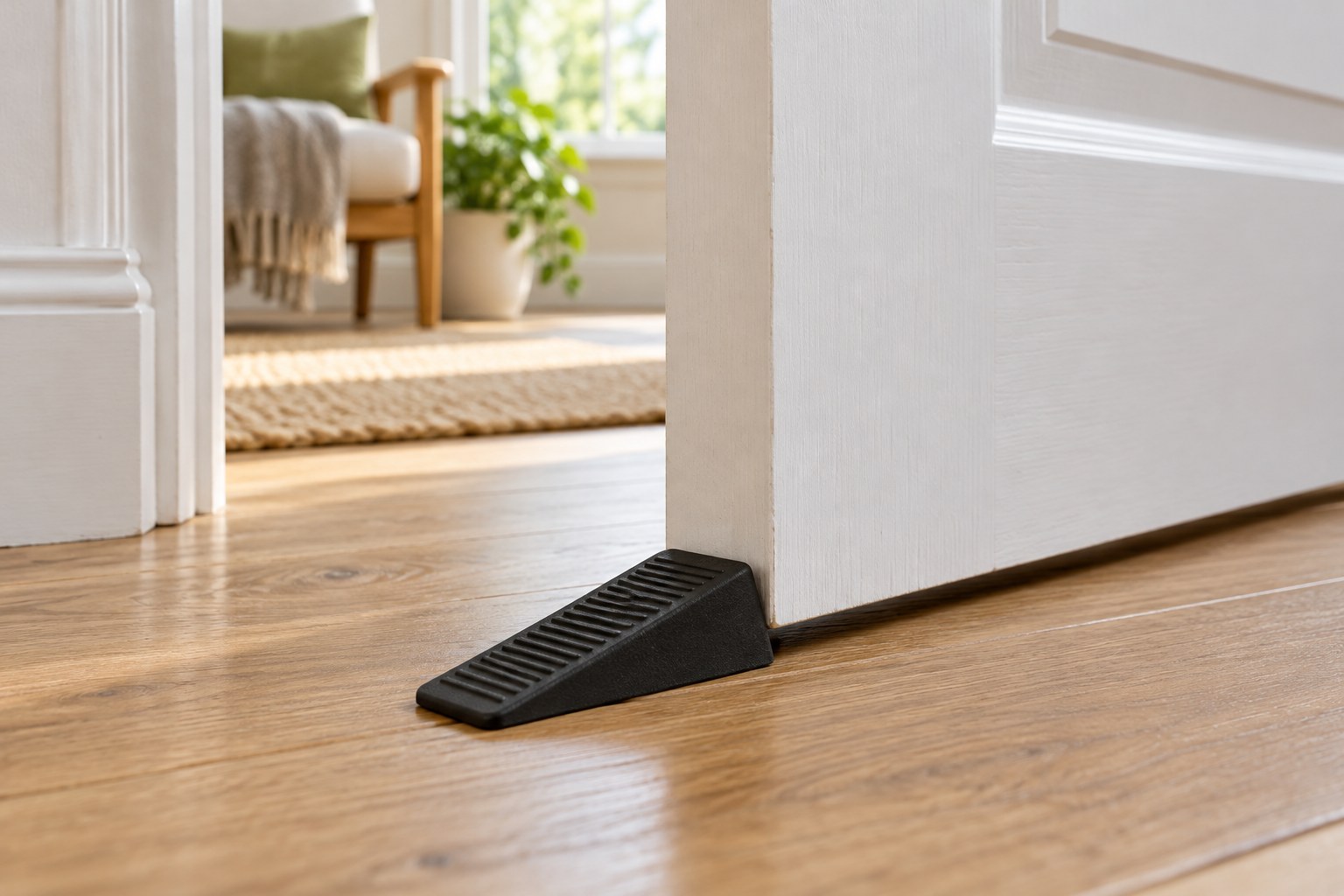
Check the full route, including rugs and changes in floor level. A loose wedge that works on bare flooring may move when it sits partly on a rug. Conversely, a tall floor stop can become an obstacle when it stands in the walking route. Mark a proposed position temporarily and walk through the doorway carrying something ordinary, such as a laundry basket.
Choose what the stop needs to do
A bumper limits travel; a wedge or holder may also keep a door in one position. Those are different jobs. For an ordinary interior door that only needs wall protection, adding a holding mechanism creates extra steps every time the door is used. Do not use a stop to defeat a door's intended automatic closing or latching function.
A wall bumper has no floor footprint, but its location must line up with the approaching handle or another suitable contact surface. A baseboard-mounted stop may sit lower and require enough projection to protect the handle above it. A loose stop is easy to move for cleaning, although that also makes its position less predictable. Consider who will return it after vacuuming.
Look closely at the contact surfaces
Inspect both sides of a freestanding stop: the part touching the door and the underside resting on the floor. The weight, a soft-looking covering or a rubber appearance alone does not establish compatibility with a particular finish. Read the material guidance and try an inconspicuous area where appropriate. Grit trapped beneath a stop can scratch even when its clean base feels smooth.
For a fixed fitting, establish whether the proposed mounting surface and fasteners are suitable before drilling. A thin cabinet panel is different from a solid baseboard. Where the wall or floor construction is unknown, use an appropriate installer rather than choosing a longer screw by guesswork. Keep the original fixings information for later replacement.
Check the result with an ordinary opening
After installation, move the door gently through its range and confirm that the handle remains clear. Check for an unwanted rebound into nearby objects and make sure the door can still close normally. A stop that repeatedly shifts, loosens or compresses too far needs a different arrangement. Keep its contact pad and the surrounding floor clean, and replace a damaged pad before the hard fitting begins making the very marks it was intended to prevent.